

Still Standing: An Exclusive Sit-Down with Stephen “Pappy” Strong on Survival, Purpose, and the Life He’s Building Now

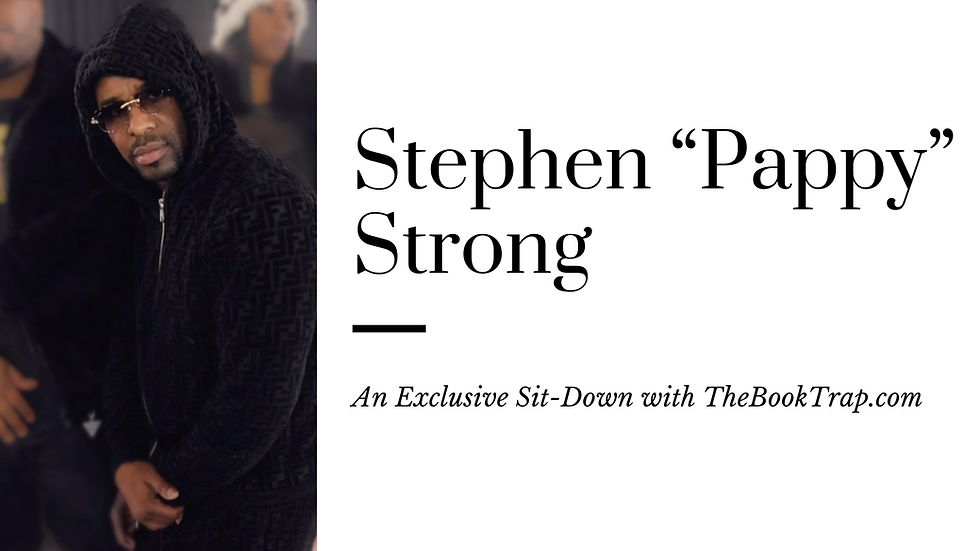
There is a version of Stephen “Pappy” Strong that most people never get to meet. The Book Trap had that conversation exclusively, sitting poolside with Pappy to talk about where he’s been, what it cost him, what almost took him out for good, and the publishing house he’s now building from the ground up.
What we found was a man who has earned every word of his story, and is finally in a position to tell it on his own terms.
The Long Road In
Pappy doesn't sugarcoat where he came from. By fifteen, the streets had already started writing his record for him, and for over a decade, the system became a revolving door he couldn't seem to outrun. The longest stretch he ever made it home before going back was ten months. He moved through some of New York’s most well-known facilities: Attica, Clinton, Sing Sing, Green Haven, Elmira, and others. By his own account, he wasn’t just surviving inside...he was still operating in the same way that put him there.
But something else was happening alongside all of that. He was taking programs, and not just signing up for the ones that got him out of his cell. He enrolled at Mercy College, studying psychology and African history. He completed ART, AVP, PACE, T for F, a divinity class covering multiple religious traditions, and Rehabilitation Through Arts, a program whose facilitators held seats on the Academy Awards board. He connected with Exodus Transitional Community and the Fortune Society, organizations that began working with him inside and followed him home. He was building something in himself, quietly, before he even fully understood what it was for.
The Work of Becoming
There was no slow fade from who he was into who he became. It had to come all at once, or it wouldn't come at all.
Caught in a facility sweep while still carrying product, Pappy swallowed the bags rather than surrender them, and the bags opened in his stomach. He made it through an intake screening before it hit him. Then he seized eight times. Staff responded with eight rounds of Narcan. He stopped breathing, and they had to bring him back...three times in total.
He woke up two days later in a coma with no memory of what had happened, tubed and disoriented, not knowing what day it was. Doctors told him he had a 30% chance of living. What he didn’t learn until afterward was how close the timing had come to being fatal in a different way. The incident occurred in the earliest days of the COVID-19 pandemic. One day later, Governor Cuomo’s order to suspend resuscitation efforts went into effect across New York facilities to preserve ventilators. One day was the difference between coming back and not coming back at all.
He described what he experienced in a way that made you grasp at your chest, a gesture to remind you to breathe as he shared every detail, every thought, and every sense of imagery possible...to put you in that hopsital bed with him. He mentions a small dot of light that expanded into something vast and walls of light opening up around him. He stood there, but he didn’t walk toward it. Instead, when he came back, he knew that something had been decided.
“God must be testing to see if I’m ready,” he said proudly. “He has a purpose for me. Because there’s no reason — with everything I’ve been through — that I should still be here.”
“What will help you survive in one season will suffocate you in the next, when you’re being called to something bigger.” Stephen "Pappy" Strong
After the near-death experience, Pappy was placed in a mental health observation unit, a bare cell, a smock, AC running cold around the clock, lights on 24 hours, a thin mat on the floor and nothing else. A space designed, whether intentionally or not, to break a person down. He watched men around him come undone, and he made a decision to sit still.
When a psychiatrist eventually cleared him and then disappeared for four days without releasing him, he didn’t react. He didn’t argue. He didn’t give them what they were waiting for. He just stayed calm.
“I’m four steps ahead,” he said confidently. “I can see what they’re trying to do. I’m not entertaining it.” They released him the next day.
He talked about learning to handle conflict "socially" instead of "physically." “My values are my family and my freedom,” he said simply. “What’s more important, your family, your freedom, or your ego?” He’d made his choice. What will help you survive in one season will suffocate you in the next, when you’re being called to something bigger.
2 Crowns Publishing and What He's Building Now
Pappy has been home for two years. He has already broken his own record, twice over, and he’s focused on goals that keep pulling him forward. He co-founded 2 Crown Publishing alongside Charnise Thomas, building a platform rooted in authentic storytelling for writers who know what it means to have a story that needs too be shared.
His book, Never Make the Same Mistake Twice, is the first major release under the imprint, and it carries the weight of a man who has actually lived the title. He’s also working to reconnect with every program and organization that invested in him while he was inside, so they can see firsthand what their work produced. He’s reaching back so others can reach forward.
When we asked what he would tell his younger self if he could, he didn’t hesitate long. He talked about patience and surrounding yourself with people who actually want good for you. He noted the importance of following the people who were already doing it right. “I wish I would have listened,” he said. “I wish I would have had more patience with life.”
A Note Before The Story Begins
The Book Trap is proud to share the following excerpt from Pappy’s debut novel, Never Make the Same Mistake Twice. This is from the foreword, a piece that comes before the story even starts and earns its own page for a very specific reason.
What most people don’t know is that when a book is mailed to someone incarcerated, it gets scanned. A corrections officer is given only a few minutes to decide whether a piece of literature is permitted to reach the yard — and that decision is rarely made with care or nuance. Books are judged by covers, titles, and the first pages a guard happens to flip to. In many facilities, the bar is impossibly high. Believe it or not, some jails and prisons do not allow inmates to read anything unless it is religious material. Everything else is treated as a risk.
Pappy wrote this foreword knowing exactly where he wanted this book to go. He wanted this bold declaration placed at the front of the work so that anyone holding it, guard or inmate, skeptic or believer, would know immediately what they were holding and why it matters.
“Let’s try to never make the same mistake twice. However, if we should make a mistake, we should become educated through our errors and offer advice to the younger generation so that they can gain from our experience, the benefit of a more positive outlook on life. If you are still alive to realize your mistake, brothers and sisters, then it’s time to correct it. We don’t need to sell drugs to succeed financially in this world. It takes hard work and dedication to get where we need to be… Which is why we have to start accepting full responsibility for our actions. Let’s become known as a person who rose out of the hood, enrolled into college, reached higher levels and heights of life that people thought that we couldn’t reach at the outset. Instead of being in the Matrix, let’s be outside of it and become lawyers, justices and legislators.” - Stephen "Pappy" Strong
He doesn't reach for a distant example, he points to Barack Obama, a man who came from Chicago and climbed anyway, against every ceiling the world tried to place on him. He asks his readers to do the same. To step outside the system that was designed to keep them in it. This book is not asking for sympathy. It is issuing a challenge.
We are in a Literary Crisis, and We Are Still Banning Books
The data on reading in America is not subtle. As of 2024, 70% of fourth-grade students nationwide are reading below proficiency, the worst performance recorded in nearly 30 years. Forty percent of fourth graders and a third of eighth graders scored below the most basic level on the National Assessment of Educational Progress, numbers that have only worsened since the pandemic. Meanwhile, 54% of U.S. adults read below a sixth-grade level, and 28% of adults aged 16 to 65 read below the equivalent of a third-grade level, a figure that has grown by nearly 47% since 2012.
If the crisis looks alarming at the youth level, consider what it looks like inside our prisons. Over 70% of incarcerated adults in the United States cannot read above a fourth-grade level. The Department of Justice has stated plainly that “the link between academic failure and delinquency, violence, and crime is welded to reading failure.” Yet inmates who receive literacy help while incarcerated have only a 16% chance of returning to prison — compared to 70% for those who receive no help at all. The math is not complicated. Access to reading is not a luxury. It is a intervention.
And yet the system continues to make access harder, not easier. Research confirms what most of us already understand intuitively: reading reduces stress by nearly 20% in as little as five minutes. People who read for pleasure report a 20% higher rate of life satisfaction. Regular reading is linked to a 40% lower risk of cognitive decline. Reading fiction helps people feel less lonely, more empathetic, and more equipped to understand experiences outside their own. These are real benefits. For someone sitting in a cell trying to figure out who they are on the other side of their worst decision, a book can be the difference between a revelation and a relapse.
We cannot call ourselves a society committed to rehabilitation while simultaneously deciding that incarcerated adults do not deserve the basic right to read. We cannot stand in front of a literacy crisis at the youngest level, where 70% of our fourth graders are already behind, and then turn around and ban books from the adults who grew up in that same failing system. Urban fiction is not the problem. Restricted access is. And the idea that a story has no value because it reflects real life rather than sanitizing it is not a policy. It is a prejudice.
Sometimes the most powerful message arrives wrapped in a story that sounds exactly like your own life. That is not dangerous. That is literature doing what it has always done.
How You Can Support
Supporting Stephen “Pappy” Strong right now is as simple as it gets: buy the book, read it, and tell somebody. Share it with anyone in your circle who needs to hear that the cycle can be broken. Share it with anyone who has the platform or the influence to advocate for more reading programs, more book access, and more pathways for incarcerated individuals to benefit from the exercise of reading, regardless of the content’s genre or origin.
Pappy fought his way back from 30% odds. He sat still in a cell designed to break him. He came home, built a publishing house, and put his declaration on the first page of his debut book so the right people would know exactly what they were holding. The least we can do is make sure his message travels as far as it was always meant to go.

Keaidy Bennett is the Founder and CEO of LexxiKhan Presents Publishing, a hybrid publishing house she built from the ground up over 13 years without asking anyone's permission. She is a poet, ghostwriter, publicist, and advocate whose work has produced over 150 bestsellers and secured educational contracts with school districts across the country. She believes storytelling is an act of service, and she has built an entire ecosystem to prove it.


Comments